
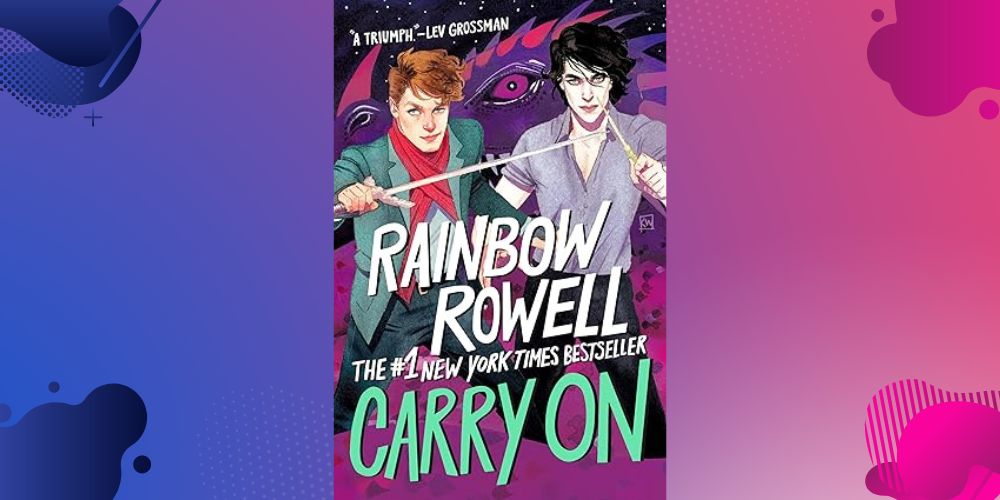
Publication date: October 2015
LGBTQ+ author? Unknown
Series: Simon Snow Book #1
Setting: Modern day London
Content warnings: Magical fighting, death and what some consider bi erasure
The Simon Snow series filled the hole in my YA fantasy loving heart when I discovered what a horrific transphobe JK Rowling was. This is my fourth annual re-reading of the series. I am in love with this much more inclusive, very queer retelling of a magical “chosen one” story.
Simon Snow (Harry Potter) is an orphan living in modern day London when the headmaster of a magical boarding school comes to whisk his away. Carry On starts in his last year of school. Simon is the most powerful magician who has ever lived. He has to save the world from the insidious humdrum, who is stealing magic and sending evil creatures to attack magicians.
Simon’s best friend is a brainiac named Penelope (rhymes with Hermione). Many Harry Potter fans have read Hermonine as black or mixed race because of her outsider status and the racial slurs she endures (mudblood). JK Rowling doesn’t like this saying “Idiots are going to idiot.” But Rainbow Rowell fixed it for her and made Penelope half-Indian, half-white British girl.
Simon’s girlfriend at the start of the book is Agatha. She loves pink, dresses and other stereotypical girly things. She is not really into being a magician and just wants to hang out with her normal friends. Some readers hate Agatha, thinking she is weak and a criticism of femininity. I don’t read her that way though. She knows what she wants and goes after it. She is also the only character that acts like a normal person would during a crisis. Instead of narcissisticly thinking that she — a child all on her own — can save the world, she goes and tells an adult and gets to safety. Very sensible.
Lastly we have Baz, my favourite. He is from an old magic, old money family. He was turned into a vampire as a young child during an attack on his school. This is kept a secret as vampires are considered villains. Baz echoes Draco from Harry Potter. Baz is also a person of colour, being half-Egyptian. However, his skin became unnaturally light grey when he became a vampire.
Baz and Simon were assigned as roommates by the sorting hat, I mean magical cauldron. They are both powerful magicians and quickly become obsessed with each other. Ostensibly with killing each other, as they see themselves on opposite sides of a magical war. They are constantly fighting. We learn later that Baz our gay vampire is obsessed with Simon in a more … romantic way.
Agatha eventually breaks up with Simon. Simon and Baz agree to a temporary truce to solve a mystery together. They start spending a lot of time together. Our Harry/Draco — I mean Simon/Baz – romance begins! It’s a YA book so they hold hands and make out a lot.
One of the main criticisms of this book is that it has no plot. I would somewhat agree with this. The first half of the book starts painfully slowly, as almost all the world building is recalled as past events. Then the energy starts to pick up when the romance begins, though there is still very little plot for a fantasy novel. This does not make me love it any less.
Almost all of Rainbow Rowell’s books center around a heart-twisting romantic relationship, and this book is no exception. Nothing too scary happens and nothing happens too quickly either. Others may want some more excitement in their books and that’s fine. But that’s not this book, and it doesn’t make me love it any less.
Bisexual erasure
The other criticism this book faces is what the author does with Simon Snow’s sexual orientation.
When we meet Simon he is three years into his relationship with Agatha. We do get the sense that they genuinely had romantic feelings for each other, but it didn’t work out.
Simon and Baz’s first kiss in the middle of a forest fire while fighting the humdrum. During this stressful event, Simon starts wondering if he is gay. He then says to himself, “I decide I don’t have to answer that last question right now.”
In quieter moments after that first kiss, Baz repeatedly pressures Simon to say if he is gay or not. The first time Simon says, “I guess I’ve never thought much about what I am. I’ve got a lot on my plate.” The second time Baz exasperatedly asks him how he could not know if he was gay or not. Simon says, “I try not to think.” The pair continue to be romantic with each other despite Baz’s needling and Simon’s lack of an answer.
Some reviewers feel this is bisexual erasure. Bi erasure is tendency to ignore or otherwise explain away bisexuality. There is a fantastic essay about this on Casey the Canadian Lesbrarian’s blog. She writes:
… [T]his book disappointed me in a way that makes me angrier and angrier the more I think about it. Namely: the way Carry On deals with queer sexuality is so deeply monosexist (enforcing the assumption that people are either gay or straight and therefore erasing bisexuality) that I want to chuck it at the wall.
I see where people are coming from and respect that interpretation. However, as someone who has been in romantic relationships with people of all sorts of genders and has often identified as bisexual, I do respectfully disagree.
For all of Baz’s vampire super strength, immortality and good looks, he is also an incredibly insecure teenager who finally gets to make out with the kid he has been crushing on since he was 12. This is Baz’s first romantic relationship. He is also terrified of being discovered as a vampire and has a lot of internalized shame. Baz is so nervous about losing Simon, he continues to insult Simon and push him away even as realizes he is in love with him. I see Baz’s pressure on Simon as an extension of this profound insecurity.
I’ve dated insecure gay people who behaved like this. Bisexuality was their worst nightmare, feeling incredibly paranoid that I will dump them for a more socially acceptable “opposite” gender partner. I think it’s worth noting this book was published months after gay marriage became legal in the United States, at time when it was even scarier to be in a queer relationship than it is now.
I also take Simon at his word, saying that he doesn’t have a lot of time or energy for introspection. He grew up in an orphanage and was then whisked away to a boarding school when he was 12. Ever since then he has been attacked by creatures trying to kill him and his friends. He has been killing since he was a child. Everyone is looking to him to save the day.
One thing I love about this series is that Rainbow Rowell does not shy away from showing what the impacts of trauma are, though this is mostly in the next two books. I think not really caring to label your sexual orientation and just going with what feels pretty good is a realistic response to Simon’s violent, scary life. At the end of the book Simon gets a magical counsellor. In terms of his sexual orienation, he says “My therapist says it’s not even in the top five things I have to sort out right now.”
Again on a personal note, I have had a much less traumatic life than Simon and I’ve been alive 20 years longer than him. I’ve loved men, women and other genders. But I still don’t know my sexual orientation is. I’ve spent thousands of dollars in therapy to try to figure it out. It’s just confusing for some of us. I realize part (but not all) of my trouble is from living in a culture where bi erasure is so prominent. But I don’t feel angry when I read Simon and Baz trying to sort this out. I feel seen.
Audiobook
Euan Morton’s performance of this book is exceptional. If you have the option, I recommend the audiobook over print.
 Queer Book Reviews
Leave a comment