
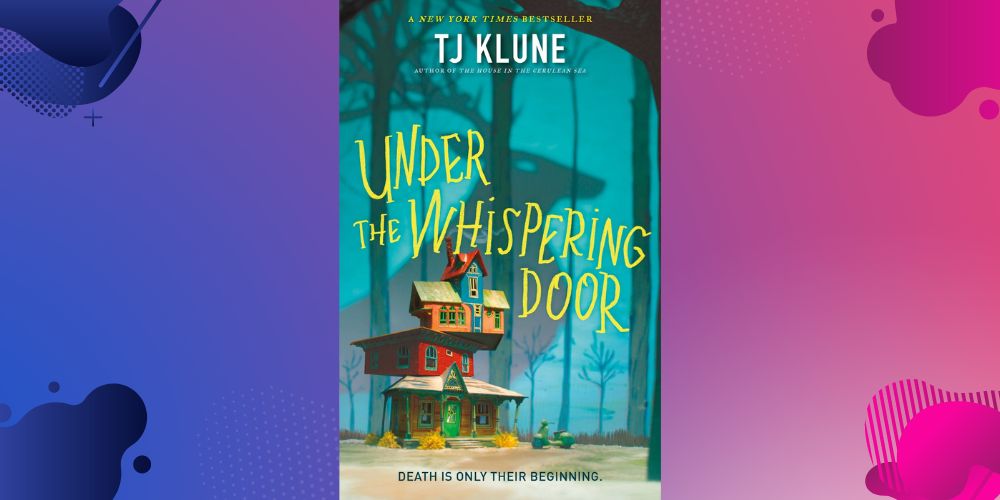
Publication date: September 2021
LGBTQ+ author? Queer
Setting: Modern day United States
Content warnings: This book is about what happens after you die, including all kinds of death like suicide and murder
I adored TJ Klune’s popular and successful novel The House in the Cerulean Sea. So of course I wanted to read more by him. Under the Whispering Door is also a whimsical, contemporary fantasy novel.
We meet Wallace in his law office as he is firing a long time employee for making one mistake. He is a cruel man obsessed with work and money.
Then he dies! The entire novel (16 hours on audio book!!) is what happens next.
As a ghost, he is whisked away by a “reaper” named Mei to a tea shop in the woods. There he meets the “ferryman” named Hugo who will help Wallace cross over to the next step in his journey. Wallace is joined by other ghosts in the tea shop throughout the novel.
What worked for me
Focusing on death is a great way to make you think about life, what’s important and what’s not. During Wallace’s stay in the tea shop, everyone is kind and supportive of him, even though he is an asshole. His icy behaviour begins to melt. He learns about friendship and helping others. It made me feel warm and cozy to read.
The world building was also fantastic. There were so many little details about what happens after you die from a practical and emotional standpoint, while also leaving some things to the imagination.
Bisexual representation
In life, Wallace was married to a woman and then divorced. After he dies, he falls in love with a man. But he never regrets his marriage to his wife. There is no conflict here for Wallace or his new love. This no-drama representation of bisexuality is rare in queer books and I appreciated it very much.
What didn’t work for me
This book is so long. And so slow. I almost DNF-ed at hour 9 or 10 because I was getting so bored. However, since I had committed so much time, I wanted to see it through. Also I trusted TJ Klune because I knew what a brilliant writer he was. And eventually the emotional pay-offs started to happen. Almost everyone got nice, emotionally satisfying endings.
Magical Negro problem
The Magical Negro is a term popularized by Spike Lee in a speaking tour of American colleges (that I was so lucky to attend). A Magical Negro is a Black supporting character who comes to the aid of a messed up white main character, selflessly helping him become a better person. They often have magical powers.
This, unfortunately, is Hugo. He can see and talk to ghosts, and he uses his magical powers to help Wallace grow into a happy, kind person. Redemption arc complete.
One might argue Hugo escapes this trope a bit, as he gets a backstory, he gets a love interest, he has a family. He has things to do besides talk to Wallace. He is also a main character, not a supporting one.
But I dunno. I am not convinced the author escapes this trope. Hugo’s selfless devotion to helping (white male) ghosts goes almost into the realm of self-harm at times.
Also, would Hugo make sense if he was a middle-aged white man? I would argue no, he would not. I am not saying white men can’t be helpful and supportive to each other. But it would have taken a lot more to build his character and backstory to make this believable. That’s what tropes are, they are shortcuts. And this one was unfortunate.
 Queer Book Reviews
Leave a comment