Publication date: September 2021
LGBTQ+ author? Non-binary and queer
Setting: The Protectorate (Speculative Fiction)
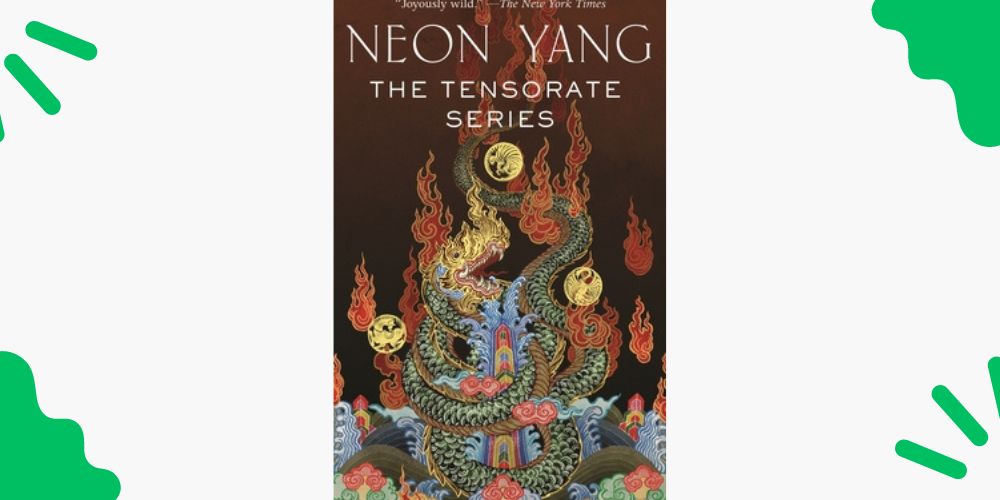
Series: Tensorate novellas #1-4 combined into one book
Content warning: Fantasy violence
I am rarely a fan of speculative fiction books — aka books not set in the real world. But I loved this series. The story is captivating in its own right, but how Neon plays with gender in this world adds something extra special.
The novellas follows Mokoya and Akeha, the twin children of the Protector, who were sold to the Grand Monastery as children. Mokoya develops the ability to see the future, a highly valued talent that keeps her tethered to the Protectorate. As the rebellion against the Protector builds, Akeha leaves and takes up with the Machinists. The novellas explore the tension between magic that just the elite can wield and the machines that the rebels are creating for everyone to use.
Queernorm gender playground
The story doesn’t really have much to do with the gender of its characters. It’s just weaved into the world building along with information about the Protectorate, nagas and Machinists. But since that’s the focus on my blog, I’m going to discuss it in detail!
We learn children dress in a gender neutral way and are referred to as they/them until they are ready to confirm their gender as male or female. After the confirmation, at least some people visit a doctor of sorts to undergo a physical transition. The gender confirmation usually happens as a teenager, but there are mentions of very young children being certain of their gender.
It’s unclear to me what bodies people are born with, which I think is deliberately not clear. Do they have physical sex differences like we do here in our world? Are they genderless beings before they confirm? There seems to be a lot more women than men, which also made me wonder if everyone was born “female” and a few choose to change into men. I love how this whole somewhat trans-affirming system is described without going into detail about peoples’ bodies.
I was describing this gender system to a friend, and she said this seemed horrible. I had only thought about it as a positive, how every single person must come out and it’s no big deal. But I suppose it would be horrible if you were something other than a man or woman, or maybe you changed your mind!
Luckily we get to see this play out in book two, where we meet someone who confirmed their gender but never went to the doctor. They go by they/them pronouns and have a very different name than everyone else. We have no idea what their body looks like, other than a subtle hint, which I think is a strength of this being a book and not a movie!
This book is also very poly-affirming in it’s own speculative fiction way. I felt tender and squishy about it.
 Queer Book Reviews
Leave a comment